
Redesigning the Mentor Buddies Onboarding Experience
Updated: Jan 30, 2024

Role: UX, UI, User Research
Overview
Mentor Buddies is a mobile app for designers to get detailed answers to their questions in exchange for a small donation to the charity of the mentors choice.
Problem
After beta testing, Mentor Buddies noticed that users were not completing the onboard and connecting with a mentor.
Solution
I developed a new onboarding flow to enhance user experience, including expanding topic options and improving copy quality. This aligns with the business goal of making users feel confident in finding a mentor through the app.
The Process
Stakeholder Interviews to understand business goals
We conducted a stakeholder interview with Grace, founder of Mentor Buddies, to understand the goals of the app, what’s currently working, and what needs improvement.
Goal: An onboarding experience that allows users to easily and confidently find a mentor to chat with.
What's currently working: Users have reported that they've gotten feedback from their mentors that was constructive and created great connections with their mentor.
What needs improvement: the onboarding experience has a lot of user drop off
After the interview we looked at analytics. I focused on the first part of on boarding where a user has to sign up and pick their interest of choice.
Identifying Points of Friction
Using analytics from our beta release, we identified a few possible points of friction in the onboarding process to focus in on:
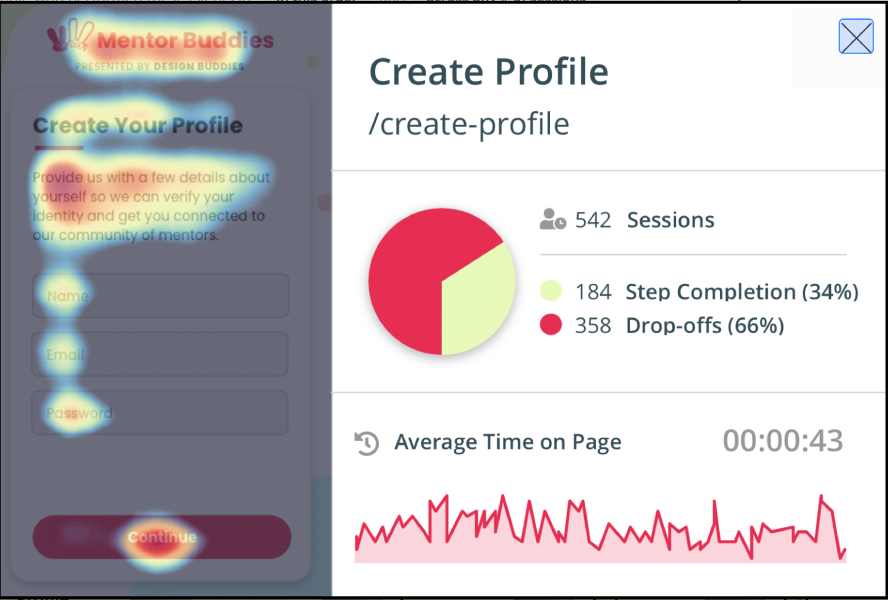
High completion at the ‘Welcome’
High drops of at ‘Create Profile’
High completion at ‘Verify Number’
Opportunities of Improvement
To gain a better understanding of our user’s journey through the onboarding process, I analyzed and synthesized findings from usability tests and created a user journey map.
I learned:
🤔 Users were not sold that the platform will help them get what they want
🤷 Users did not understand why certain information was needed within the onboarding process
😐 Users expected the app to have specific topics they could cover with their mentor
After analyzing and collecting information from interviews, user testing, and the journey map, I started to pull problems and turn them into solutions.

Sketching Solutions
I sketched some potential features that might support both user and business goals.
Here are a few of the features and concepts that I began working on to support these needs:
Changing the order of the flow
Creating a preview of the mentor list
Expanding the topic options
Preview of mentor list
I prioritized expanding topic options and improving copy quality. This will help users feel more confident in finding a mentor and aligns with business goals.
Highlighting Key Features
Getting Specific

Users can now select their area of interest and preferred topic to discuss with a mentor. Users wanted more specific topics to go over with their mentor. Based on analytics, I expanded on the options available for each area of interest. Users can now choose from a list of specific topics to discuss with their mentor, creating a more personalized experience that aligns with our business goals of finding the perfect mentor match.
Gaining Clarity

Users are informed about how their information is used to create a better experience. The feature ensures clear communication with users throughout the experience. This approach aims to boost user confidence and achieve business goals.
Putting Things to The Test
I wanted to test the clarity and flow of our new design. My hypothesis was that the revised design would offer better clarity and a more intuitive experience for users.
To validate this, I conducted an experiment: I shared two links in a Facebook group of UX designers, one featuring the original design and the other showcasing our new design. Each link was accompanied by a prompt asking users to imagine themselves as new users seeking mentorship in UX design, followed by questions evaluating the platform's clarity and their confidence in finding the right mentor.
The response, albeit with an uneven number of participants, was informative. While I acknowledge that the sample size was small, with 5 responses being the minimum for statistical significance, the feedback was still invaluable.
For the original design, the average scores were 4.56 for understanding the platform and 3.33 for confidence in finding the right mentor. The new design, however, showed a notable improvement – 4.6 for understanding and 4.13 for confidence.
This feedback directly addresses the initial pain points:
uncertainty about the platform's ability to meet their needs
clarity of the onboarding process
desire for specific topics to discuss with mentors
It's clear that our new design is a step in the right direction, moving us closer to a product that truly resonates with our users. However, I believe we can deepen our understanding further by conducting user interviews to explore the reasons behind their responses.
So what's the next steps?
I am confident that these designs are ready for the next iteration of a beta release.
For the next iteration, I recommend the following steps to further refine our solution and improve the onboarding experience:
Completion vs. Drop-off - Compare the completion rate between the new flow and the original flow to see how they compare since this was one of the major problems during the beta launch.
User Interviews - Gain insight into how this flow can improve and if it solves the user's need for more specific topics.
Overall, I am optimistic about my progress in designing and developing the solution. Implementing the suggested steps can refine the product, improve the user experience, and bring confidence in product launch and success.
It is important to continue testing and gathering feedback to ensure that we meet the needs of our users. With these efforts, I am confident that we will achieve our goals and create a successful product.


